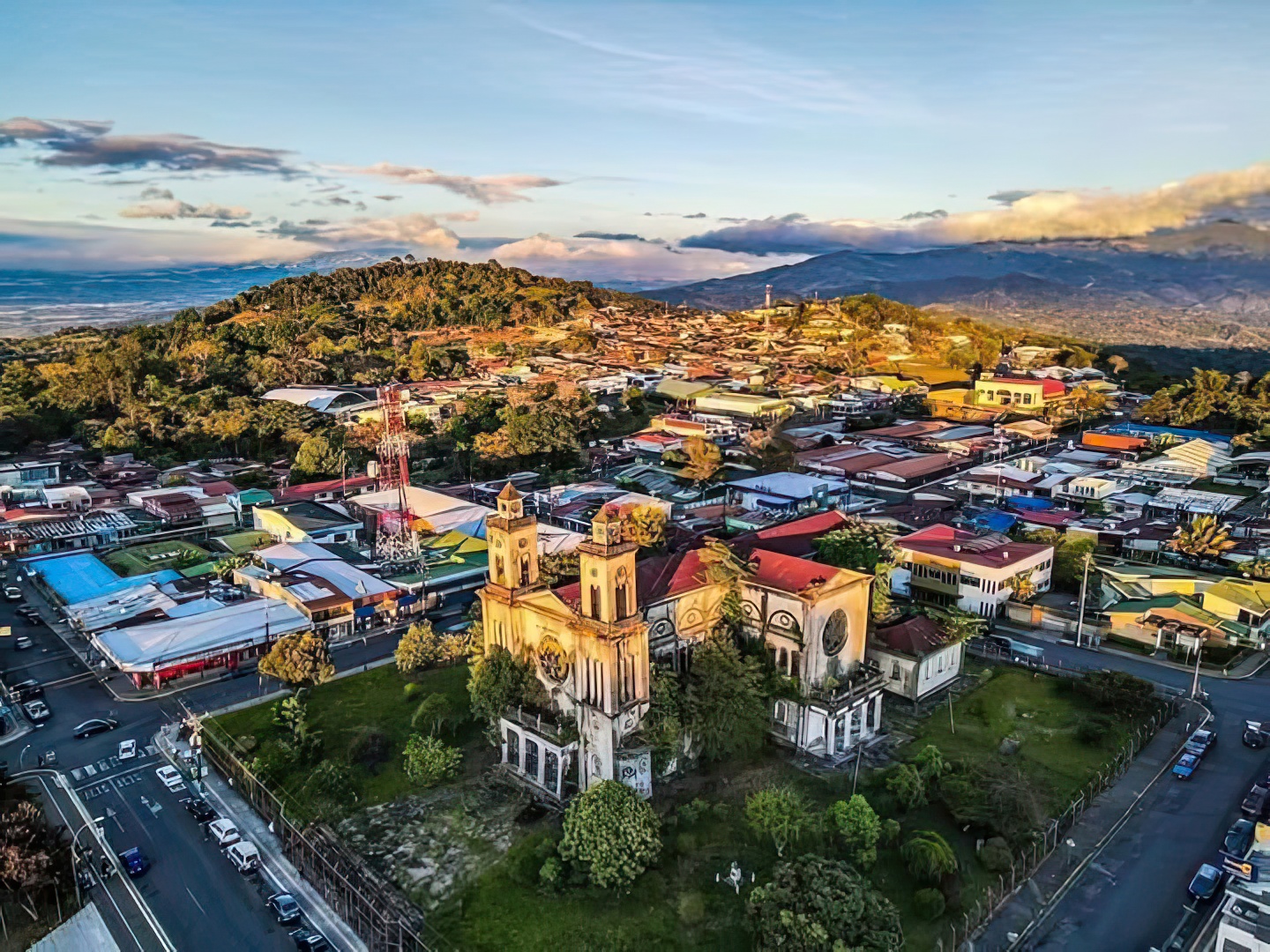
Anyone projecting how fast lots will sell on a Costa Rican hillside eventually has to answer an unglamorous question: can a buyer actually live here, or does every ordinary errand turn into a trip to Escazu? The answer determines who your buyer is, how fast lots move, and what you can charge. It is not a question that markets well, which is exactly why it is usually answered badly.
What follows is a short list of San Antonio de Puriscal services and amenities, with distances, and an equally direct account of what is missing. Distances are measured from the San Antonio district center and are approximate. A parcel a few kilometers up the hill adds minutes to every figure below.
Health care: better than the map suggests
This is the category where Puriscal outperforms expectations, and it is largely an accident of geography favorable to San Antonio specifically. The Centro de Atencion Integral en Salud, or CAIS, sits on Route 239 roughly a kilometer and a half from the San Antonio district center. It is closer to San Antonio than it is to downtown Santiago, which is about three and a half kilometers away. Opened in December 2010, it is a substantially larger facility than the neighborhood clinics that serve most rural areas.
The CAIS operates a 24-hour emergency service, year-round. It carries the basic medical specialties, meaning pediatrics, gynecology, internal medicine and general surgery, alongside laboratory, X-ray, ultrasound, electrocardiography, pharmacy, dentistry, physical therapy, psychology and minor surgery. It includes operating-room capacity and has performed surgeries in coordination with Hospital San Juan de Dios in San Jose. It serves not only the Puriscal area but neighboring communities including Guayabo, Fila de Mora and Palmichal de Acosta.
Below the CAIS, the public system runs EBAIS primary-care clinics distributed across the area’s districts, which handle routine consultations, vaccinations and prescriptions without a trip to the main center. Private care fills the gaps around it. Santiago has several independent pharmacies open into the evening, most with a general practitioner available, plus private dental practices and two well-regarded veterinary clinics. For most routine medicine, a resident of San Antonio has a five-minute drive, not a ninety-minute one.
Where health care stops
The CAIS is not a full general hospital. There is no intensive care unit, no cardiac catheterization lab, no trauma center and no comprehensive specialist roster. Complex and emergent cases are stabilized and referred into the national network, which for this catchment means Hospital San Juan de Dios in San Jose.
On the private side, the internationally accredited hospitals that many foreign buyers assume they will use, in Escazu and San Jose, are roughly an hour and a half away. The drive is a real ninety minutes, on a two-lane mountain road that connects to a congested toll highway.
For a healthy buyer, that is an acceptable arrangement: emergencies are handled locally, elective specialist care is a planned trip. For a buyer managing a chronic condition requiring frequent specialist visits, or one who expects on-demand private care at international standards, it is a genuine constraint. Any developer selling to a retiree demographic should be honest about which of those two buyers is walking the lots.
Schools: adequate locally, and the largest single gap
Public education is fully present. Each district including San Antonio has a primary school. Secondary education is served from Santiago by the Liceo de Puriscal on the academic track and the Colegio Tecnico Profesional de Puriscal on the technical track. The Ministry of Public Education runs a regional office in Santiago, and the national vocational training institute, the INA, maintains a presence there as well.
Private bilingual options exist and are local. Colegio Bilingue Naciones Unidas and Saint Spirit School both operate in Santiago, roughly ten minutes from San Antonio.
What does not exist is an internationally accredited school. There is no International Baccalaureate program, no United States-accredited college-preparatory school, and nothing comparable to the institutions in the Santa Ana and Escazu corridor that expatriate families in Costa Rica typically choose. Those schools are ninety minutes each way, which is not a viable daily school run.
This is the single largest amenity gap in the area, and it is the one most likely to shape absorption. A subdivision here does not sell to relocating families with school-age children pursuing an international curriculum. It sells to retirees, semi-retired couples, remote workers without children at home, second-home buyers and families comfortable with the Costa Rican public or local bilingual system. That is a substantial market. It is not the same market, and a pro forma that assumes otherwise will be wrong about pace.
Banking and administration
Santiago carries branches of all three major public banks: Banco Nacional, Banco de Costa Rica and Banco Popular. Two local financial cooperatives, Coopepuriscal and FIDERPAC, also operate in town. ATMs are available at the branches, inside the larger supermarkets and at several minisupers, most of which also handle utility bill payment.
Branch hours are weekday-only, generally from around 9 a.m. to 4 p.m., closed Saturday and Sunday. Queues are a standing local complaint. Service is conducted in Spanish; do not assume English-speaking staff. There is no private or international bank branch in the area.
Santiago is the seat of the Puriscal area government, and that is easy to undervalue. The Municipalidad de Puriscal, the regional prosecutor’s office, the education ministry’s regional office and the national production council all sit within a few blocks. For a developer, that matters concretely: land-use certificates, construction permits and municipal tax matters are handled locally rather than requiring repeated trips into the metropolitan area.
Groceries and daily retail
San Antonio has its own supermarket. Super los Jaulares sits on Route 239 within the district and is open daily, roughly 6 a.m. to 7:30 p.m., which covers ordinary daily shopping without leaving the district. Several minisupers operate alongside it.
Full shopping is in Santiago, about four to five kilometers away. Maxi Pali, the Walmart-owned discount format, is the largest store, with an in-store pharmacy and ATM. Super Mora operates two locations, Super Llerry runs 6 a.m. to 10 p.m., and Super Los Bomberos stays open until midnight. The Mercado Municipal handles produce, meat, fish and poultry from independent vendors six days a week.
For a development project specifically, the building-supply picture is worth noting. Santiago supports three substantial hardware and construction-materials suppliers, Jivis Ferretero, Comercial Puriscal Macho Cruz and Coopepuriscal, plus agricultural supply. Cement, block, rebar and finish materials are sourced in town rather than hauled from the metro on every order.
Two 24-hour fuel stations operate in Santiago. There is none in San Antonio itself.
Where retail stops
There is no Automercado, no PriceSmart and no Walmart supercenter. There is no shopping mall and no multiplex cinema. Imported and specialty groceries, warehouse-club buying and chain retail all require a trip to the Santa Ana or Escazu corridor.
Framed accurately, that is a monthly errand rather than a weekly one. A household provisions itself normally in Puriscal and drives to the metro for the things Puriscal does not stock. That is a meaningfully different proposition from driving to Escazu every week, and it is the distinction a buyer will want made honestly before closing rather than after.
Eating out and everyday life
San Antonio itself supports several restaurants, including establishments near the CAIS and along Route 239. Santiago adds more range, including a handful of places that draw diners from outside the area. This is not a restaurant scene. It is enough that a household does not cook every meal. Emergency services, a fire station, a police delegation and Red Cross presence are based in Santiago.
What this means for absorption
Read the inventory as a whole and a clear picture emerges. Services clear the threshold of habitability comfortably. A resident of San Antonio de Puriscal has 24-hour emergency medicine roughly five minutes away, primary care, pharmacies, dentistry, three banks, multiple supermarkets, full building supply, fuel, schools and municipal administration all within a ten-minute drive.
What services do not do is clear the threshold of suburban convenience, and two specific gaps do most of the work: international-curriculum schooling and on-demand private specialist medicine. Both point at the same conclusion. This location serves buyers whose lives do not require daily access to the metropolitan area, and it serves them well. It does not serve buyers whose lives do.
For anyone underwriting a subdivision here, the practical consequence is that absorption pace is governed less by the service inventory than by how precisely the marketing targets the buyer the inventory actually fits. The services are a floor, not a differentiator. The differentiator is land price, elevation and view, and the honest framing of a ninety-minute distance as a feature for the buyer who wants it.
Verify it against your own parcel
Every distance above is measured from the San Antonio district center. Yours will differ. Before relying on any of it, drive the routes from the actual property gate to the CAIS, to the Santiago town center and to a supermarket, and do it once in the dry season and once in the rain. Confirm current service offerings directly with the CAIS and with any school you intend to reference in marketing materials. Facility hours, staffing and specialty availability change.
This article is general information, not legal, medical, tax or investment advice. Distances, hours and service offerings are approximate and drawn from publicly available sources as of publication; they change without notice. Verify independently before making acquisition or development decisions.